Pillar · Ads & Funnel
Your website and your ads: how to build a funnel that actually converts
Ads bring the right people to your website; the website turns them into clients. On their own, each one is half a job. A funnel that converts aligns the ad, the landing page, and the offer, and measures every step, so you always know where visitors drop off and what to fix.
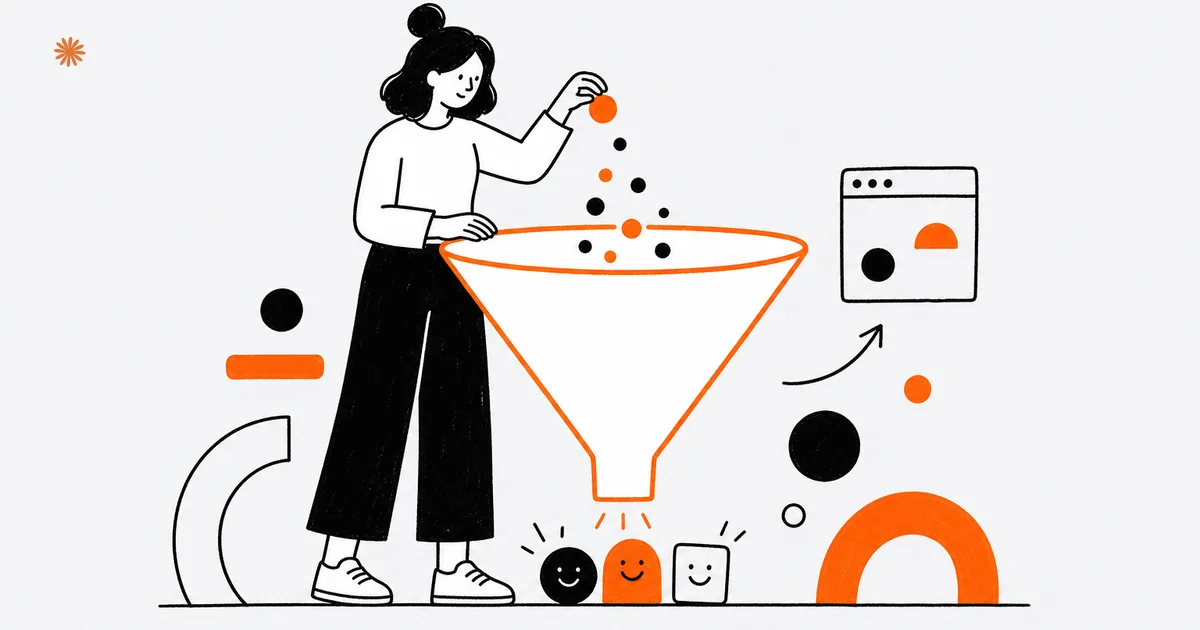
What is a conversion funnel (in plain English)?
A conversion funnel is the path a person travels from the moment they discover your business to the moment they become a client: first they learn you exist, then they size you up, then they act. It is called a funnel because you lose people at every step: many come in at the top, few make it to the bottom. Building a funnel means designing each step so you lose as few of them as possible.
It is not software you buy or a platform you install: it is a way of reading your customer's journey. The three classic stages are always the same, whether you sell consulting, products, or local services.
- Discovery. The person runs into your business for the first time: an ad, a video, a Google search, a recommendation. They are not buying here: they are filing you away as a possible option.
- Evaluation. They compare you against the alternatives: they visit your website, read how you work, look at what you offer, check reviews. This is the stage where the website does almost all the work.
- Action. They fill out the form, book the call, add to cart, or pick up the phone. That is the conversion: the moment a visitor becomes a lead or a client.
Think of a CPA in Chicago who wants new clients: someone sees her ad (discovery), opens the website and reads about her services for small business owners (evaluation), then requests an initial consultation (action). If even one of those stops is weak, the whole journey breaks. And this is where your website and your advertising stop being two separate expenses and become two halves of the same machine: ads fill the funnel from the top, the website converts at the bottom. The rest of this guide shows you how to make them work together.
Why do ads without a converting website waste your budget?
Because with paid campaigns you pay for traffic, not for clients: every click has a cost, and if the destination page does not persuade, that cost is gone. The bottleneck in nearly every disappointing campaign is not the ad: it is the page people land on after the click.
Picture a store that pays for flyers to bring people to its front window, but inside the lights are off, the shelves are a mess, and no one is at the register. The flyers work: people show up. It is the store that fails to close the sale. The same thing happens with ads, except every "passerby" is one you paid for.
Paid traffic is unforgiving because it amplifies whatever it finds: if the website converts, every dollar you invest brings more back; if it does not, you just lose money faster. An excellent ad pointing to a slow, confusing page with no clear call to action produces visits, not clients. And the platform will keep charging you for the clicks either way.
That is why the landing page has to be designed for the campaign, not recycled from somewhere else: same message as the ad, one single goal, a short form, fast loading. You will find the full anatomy in our guide to the landing page that makes your ads convert.
Before you raise the budget on a campaign that is underperforming, look at the landing page: in our experience, that is where the problem hides far more often than in the ad or the audience.
Why does a website without traffic stay invisible?
Because a website, on its own, does not bring visitors: it is the destination, not the vehicle. Even the best-crafted site converts zero if nobody reaches it. Traffic comes from three main channels: organic search (SEO), AI-generated answers (GEO), and paid campaigns. The first two build over time; the third switches on immediately.
This is the flip side of the previous point. Plenty of businesses invest well in their website and then stop, waiting for Google to "find them." SEO works, but it takes months of consistent effort before it delivers; the same goes for GEO (Generative Engine Optimization), the work of getting your site cited in the answers of ChatGPT, Gemini, and the other AI engines, which we explain in our guide to GEO.
Ads cover exactly that gap: they bring qualified traffic from day one, while your organic presence grows. And they have one advantage organic will never have: control. You decide who to reach, with what message, on what budget, and when to stop. You can test an offer in days instead of months.
The most solid strategy does not choose between the two channels: it combines them. Organic builds a visibility asset that gradually lowers your dependence on advertising; campaigns guarantee a steady, predictable flow of people who fit your target. The website that converts is the point where the two streams meet and become clients.
What role does each platform play in the funnel?
Google captures active demand, people who are already searching for a solution; Meta (Instagram and Facebook) works on latent demand and uses retargeting to win back people who have already seen you; TikTok drives discovery, putting you in front of a broad audience that was not looking for you. Each platform covers a different stage of the funnel.
| Platform | Funnel stage | What it does best |
|---|---|---|
| Google Ads | Evaluation and action | Captures people already searching ("employment attorney in Denver"): high intent, close to converting |
| Meta Ads | Discovery, evaluation, win-back | Shows your offer to people who fit your target but are not searching; brings back visitors who did not convert |
| TikTok Ads | Discovery | Introduces brands and products through short videos to a broad, younger audience |
The key difference is intent. Someone typing a search into Google has a need and is declaring it: your job is to be there when they look. On Meta and TikTok it is the opposite: you interrupt the scroll of someone who was not looking for you, so you have to capture attention first and build interest second. Neither approach is "better": they serve different moments in the journey.
In a well-built funnel the platforms do not compete: they hand off the same person, like runners passing a baton. Picture the typical journey. Someone sees one of your videos on Instagram while scrolling the feed and files your name away (discovery). A few weeks later, when the need becomes real, they search Google for exactly that service and find your ad (evaluation). They visit the website, leave without filling out the form, and Meta retargeting keeps the offer in front of them until they come back and complete the request (action). Three platforms, one journey: read separately they look like three expenses; read as stops along the same funnel, they become a system.
That is why combinations beat either-or choices: Meta or TikTok fill the top of the funnel by getting you known, Google closes at the bottom when the person is actively searching, and retargeting stitches the two worlds together by bringing back the people who stopped halfway. Which platform makes sense for your specific case depends on your audience and your goal: we break it down in Meta, Google, or TikTok: which one to choose.
How do you measure a funnel?
You measure a funnel stage by stage: for each phase you watch a different indicator, so you find out exactly where the traffic leaks. At the top you count reach and clicks, in the middle behavior on the page, at the bottom leads or sales and what each one costs. A single overall number never tells you where to intervene.
It is the difference between "the campaign is not working" and "the campaign brings clicks but the page does not turn them into inquiries." The first sentence produces frustration; the second tells you what to fix. Measuring stage by stage is precisely what turns a vague verdict into a diagnosis.
- The ad: how many people see it and how many click. If few click, the problem is the message or the audience.
- The page: how many stay, how far they scroll, how many start the form. If plenty arrive and bounce right away, the problem is the landing page (speed, consistency, clarity).
- The conversion: how many complete the action and what each one costs. This is the number that connects ad spend to a business result.
- After the conversion: how many leads become actual clients. A funnel that produces lots of low-quality inquiries needs fixing at the top, not the bottom.
Let's walk through a concrete case: a physical therapist launches a campaign to generate requests for an initial evaluation. The ad reaches plenty of people, but only a small share click: that is normal, the funnel narrows right here. Of everyone who lands on the page, some leave within the first few seconds (maybe the page is slow, or the headline does not echo the promise in the ad), some read and scroll, and only a fraction open the form. And of those who start it, not everyone finishes: every extra field costs a few dropouts. In the end, out of all those initial impressions, only a handful of requests remain. That is how funnels work, and it is not the point.
The point is where the steepest drop happens, because that is where you need to intervene. If few people click the ad, you work on the message and the audience. If plenty click but bounce off the page right away, you work on the landing page. If they read but never open the form, the offer is not clear or compelling enough. If they open the form and abandon it, the form asks for too much. Read stage by stage, the same funnel that seemed "not to work" hands you a precise diagnosis and an order of priorities.
Watch out for vanity metrics: likes, followers, and views feel good, but on their own they do not pay the bills. The metrics that matter always tie spend to a concrete result. Which ones to track, how often, and how to read them without being misled: it is all in our guide to ad campaign metrics. And for any of this to be measurable, conversion tracking has to be set up before you turn the campaigns on, with user consent and with privacy in mind.
Where do you start: the website or the ads?
The website first, then the ads. Paid traffic amplifies whatever it finds: sending it to a page that does not convert means paying for clicks that go nowhere. The foundation comes before the fuel: once the destination is ready, every advertising dollar starts working instead of evaporating.
Ready does not mean perfect. It means the landing page delivers a clear message within the first few seconds, loads fast even on a phone, has one obvious call to action, and keeps the form short. And it means conversion tracking is already live: without it, the campaign launches blind and you learn nothing, not even from your mistakes.
If you are starting from scratch and do not know where to grab hold of the project, the practical path is more linear than it looks: four steps, in this order.
- Prepare the destination. A landing page or a page on your website with a clear message, a single call to action, and a short form, fast even on a phone.
- Turn on conversion tracking. Before you spend the first dollar, make sure you can measure what happens after the click: without data you learn nothing, not even from your mistakes.
- Launch a single test campaign. One audience, one message, one goal, on the platform that best fits your case: a modest budget, but enough to gather data for a few weeks.
- Read the funnel stage by stage and fix it. Find the step where you lose the most traffic, repair it, then gradually scale only what proves it works.
There is a legitimate shortcut: if the full website does not exist yet, or needs a rebuild, you can start with a landing page dedicated to the campaign and build the rest afterward. It is often the fastest way to test an offer. The right order for your case, along with the signals that tell you when you are ready, is in website or ads: where to start.
On budget, the logic mirrors the funnel itself: you start with a testing phase to gather data, you measure, and you scale only what proves it works. The right amount depends on your industry, your competition, and your goal, not on some universal chart: we cover it in detail in how much budget you need to start with ads.
This is the philosophy behind the DigitiNexus Ads & Funnel service: we do not just "run campaigns", we design the complete journey, from the first ad to the page that converts, and we measure it at every stage. Because a funnel that actually converts is never one lucky campaign: it is a system where every piece does its job.
Want to find out where your funnel is leaking, or build one from scratch? Let's look at your website and campaigns together and map out where to start, no strings attached.
Book a free callFrequently asked questions
- Do I really need both the website and the ads?
- If you want consistent results, yes: ads without a converting website pay for clicks that go nowhere, and a website without traffic stays invisible. They are two halves of the same funnel: campaigns bring the right people, the website turns them into leads and clients. On their own, both return far less than they cost.
- Where do I start, the website or the campaigns?
- With the website, or at least with a dedicated landing page: paid traffic amplifies whatever it finds, so the destination must be ready to convert before you turn campaigns on. Ready means a clear message, fast loading, a single call to action, and conversion tracking already in place.
- How much budget do I need to start with ads?
- It depends on your industry, competition, and goal: there is no universal figure. The sound approach is to start with a test budget large enough to gather data, measure what works, and scale only that. Keep in mind that your ad spend and the cost of managing the campaigns are two separate line items.
- Which platforms should I advertise on?
- It depends on who your customer is and what you want to achieve. Google captures people already searching for you and works well for firms and service businesses; Meta creates demand and wins back visitors who saw you but did not convert; TikTok drives discovery through video, especially with a younger audience. The best choice is often combining them by funnel stage.

DigitiNexus — Web & Design Agency
We are a team of designers and developers specialized in SEO, Next.js and digital growth for professional firms, small businesses and startups, in the US and beyond. We build websites that bring real traffic and real clients.