Artificial Intelligence
RAG explained simply: get AI to answer with your company data
RAG (retrieval-augmented generation) connects AI to your own documents and website, so it answers with real information from your business instead of its generic training. It retrieves the right passage first, then writes the answer from that source, which sharply cuts the odds of made-up replies.
What is RAG, in plain terms?
RAG is a technique that makes AI work in two stages: first it retrieves the right information from your documents, then it generates an answer based on what it found. Instead of replying from memory with its generic training, the AI consults a real source and speaks only about what it finds there.
RAG (retrieval-augmented generation): a technique that connects an AI model to a collection of your business documents. Before answering, the system searches your content for the most relevant passages and hands them to the model, which uses them as the basis for a response grounded in real, verifiable information rather than its general training alone.
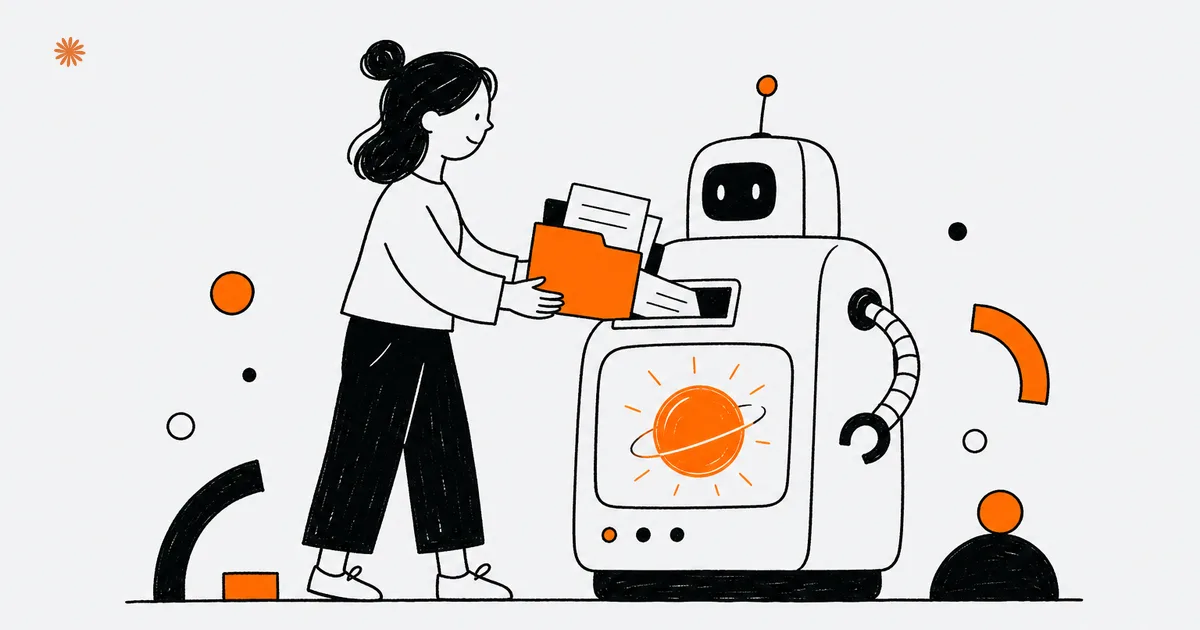
Picture a brand new hire who writes beautifully but knows nothing about your company. Without RAG, they answer off the cuff, using whatever they picked up in general. With RAG, before they say a word they go to the file cabinet, pull the right document, read it, and only then form the answer. Same hire, but now they speak with your data in hand.
The word "augmented" says it all: you are not changing the brain of the AI, you are pairing it with an external memory that belongs to you. The model stays the same, but its answers stop being generic and start being about your products, your prices, your procedures. It is the difference between a consultant who improvises and one who actually studied your file.
Why does your business need it?
Your business needs it because AI on its own does not know your company: not your prices, not your policies, not your internal procedures. RAG fills that gap. Answers are based on your real data, and the risk that the AI invents information drops sharply, because it starts from concrete text instead of memory.
The most expensive problem with generic AI is that when it does not know something, it tends to make it up in a confident tone. In a business that is unacceptable: a customer who gets a wrong price or a return policy that does not exist is a problem, not a help. RAG reduces this risk because it forces the AI to answer from a document you wrote. We explain the mechanism behind it in why AI invents answers.
There is also an immediate practical upside. Your company information changes: price lists, hours, terms. With RAG you update the document and the assistant answers right away with the new version, with no need to "retrain" anything. The knowledge lives in your files, not inside the model: you control it, you update it, and every answer stays aligned with what is actually true today.
If you are still mapping where AI fits across your operation, this is one piece of a bigger picture, and the overview in AI for your business shows how it connects to the rest.
How does RAG work, step by step?
RAG works in three stages: first it indexes your documents to make them searchable, then for every question it finds the most relevant passages, and finally it generates the answer using only those passages. It all happens in an instant, but underneath there is a precise sequence worth understanding.
- Indexing: your documents are split into small pieces and organized into a searchable collection, a kind of orderly archive where each passage is easy to find by meaning, not just by exact word.
- Retrieval: when a question comes in, the system searches the archive for the few passages most relevant to that request and sets the rest aside. This is the moment the assistant "goes to check the source" before answering.
- Generation: the passages it found are handed to the model, which reads them and writes an answer grounded in that material, often pointing to where the information came from. No relevant source, no invented answer.
A concrete example. You upload the PDF of your terms of sale. During indexing it is broken into searchable paragraphs. A customer asks "can I return a product after 20 days?": the system retrieves the paragraph on returns, hands it to the model, and you get an answer that cites your real policy. The question is in plain language, the answer comes from your document.
What can you build with it?
With RAG you build two things above all: an internal assistant that answers your team's questions by drawing on your manuals and procedures, and a customer-facing assistant that answers from your content, products, and terms. In both cases the AI speaks in your company's voice, not the model's generic one.
The internal assistant is often the first step, because the value shows up immediately. A new team member asks "how do we handle a complaint?" and gets the up-to-date procedure in a few seconds, without digging through twenty folders or interrupting a colleague. Company knowledge stops being locked in documents nobody opens and becomes something you can query in plain language.
On the customer side, RAG powers an assistant that answers from your website, your FAQs, and your price lists: hours, availability, the details of a service, the terms of an offer. It answers when you are not around, and it does so with your information, not with filler. Before you build, it helps to know whether you need a simple assistant or one that takes action, which we cover in AI agent vs. chatbot.
- Internal assistant: answers the team on procedures, manuals, and policies, cutting down repetitive questions.
- Customer assistant: answers on your site from real FAQs, product pages, and terms.
- Writing support: drafts of emails or quotes based on your documents and your tone.
What are the limits, and why does data quality matter?
RAG is only as good as the documents you give it: garbage in, garbage out. If your files are confusing, contradictory, or outdated, the answers will be too. The system does not correct your information, it retrieves it and repeats it. The quality of the assistant is the quality of your document base, not a technical detail.
Two practical limits follow from this. First: if a piece of information is not written down anywhere, the assistant cannot retrieve it, and a good system says so instead of inventing. Second: if two documents contradict each other, the answers become inconsistent. That is why the real work, before any technology, is putting your content in order: a single, up-to-date, clear, and reliable version of every piece of information.
Before you build a RAG assistant, clean house: delete obsolete documents, merge duplicate versions, and fix contradictions. An hour spent fixing your content is worth more than a thousand hours of technical tuning.
There is also a question to settle up front: company and customer data has to be handled in line with the rules. Where the documents live, who can query them, and what makes it into the answers are privacy choices, not just efficiency ones. Decide early where your files are hosted and who has access, especially when the content includes customer data or confidential information.
Want an AI assistant that answers with your company's real data, on your site or inside your team? We start from your documents and build something concrete.
Let's talkFrequently asked questions
- Do you need RAG just for a chatbot?
- No. A chatbot is only one use. RAG helps any time you want AI that answers with your data: an internal assistant for the team, help drafting emails and quotes, or internal search across your documents. The website chatbot is the most visible case, not the only one.
- Does my data stay private?
- It depends on how you set up the system. The documents stay yours, and you decide where they are hosted, who can query them, and what makes it into the answers. Make deliberate choices that respect privacy law, especially when the content includes customer data or confidential information.
- How hard is it to build?
- The technical part is accessible now and does not require training a model from scratch. The real difficulty is something else: having documents that are orderly, current, and consistent. A clean document base makes the project fast; confusing content slows it down far more than any technical issue.
- Which documents can I use?
- Just about any text from your business: PDFs, product pages, FAQs, manuals, internal procedures, website pages, price lists, template emails. What matters is that they are readable and current. The clearer and more contradiction-free your documents, the more precise and reliable the answers.
- Is RAG the same as training a custom AI model?
- No. Training bakes information into the model itself, which is slow and costly to update. RAG keeps your knowledge in external files the model reads at answer time, so you update a document and the answers change right away. For most businesses, RAG is the faster, cheaper, more controllable path.
Sources

DigitiNexus — Web & Design Agency
We are a team of designers and developers specialized in SEO, Next.js and digital growth for professional firms, small businesses and startups, in the US and beyond. We build websites that bring real traffic and real clients.